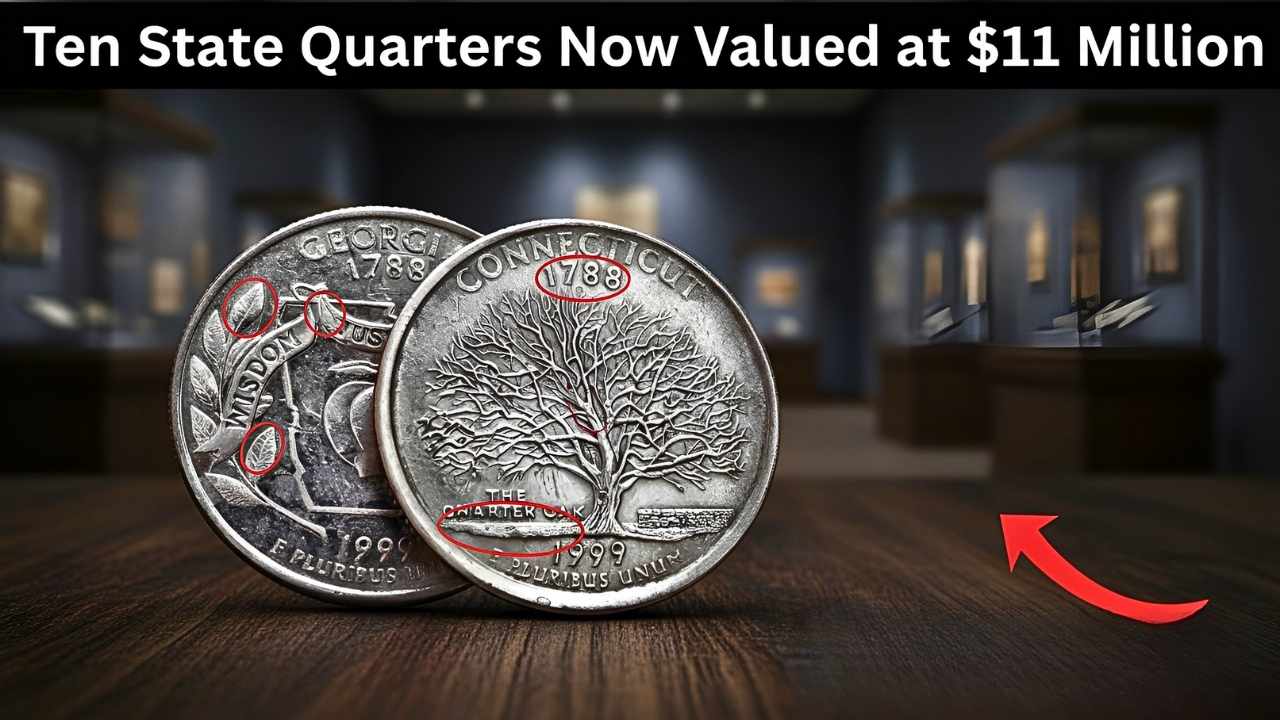
Ten State Quarters Now Valued at $11 Million: The world of coin collecting has been buzzing with excitement after reports surfaced claiming that a group of ten rare state quarters collectively reached an incredible valuation of 11 million dollars. These coins, once worth only twenty five cents each, are now the center of attention for collectors, hobbyists and everyday people curious about the hidden potential of the spare change sitting in jars and drawers. While most state quarters are common and easy to find, a small number contain minting errors or unusual traits that give them tremendous value. The idea that a simple coin could be worth thousands or even millions has created a wave of curiosity among those who wonder whether their pocket change might hold a hidden treasure.
How Ordinary State Quarters Became Million Dollar Items
State quarters were introduced to celebrate the heritage and identity of each state, and millions of them were produced during the program. Because of their popularity and widespread circulation, it may seem surprising that any could become extremely valuable. However, scarcity plays a crucial role. Some batches of quarters left the mint with rare production errors. Others were struck with unusual metal compositions or misprints that occurred briefly before being corrected. These tiny mistakes are sometimes nearly invisible to the untrained eye, yet they can transform an ordinary quarter into a highly prized collectible.
The ten quarters that reached the combined 11 million dollar valuation are believed to include a mix of dramatic minting errors. Some are off metal strikes, some contain double images and some appear to have been created on experimental planchets. Because each represents a rare moment in minting history, collectors consider them priceless.
Why Minting Errors Can Create Extraordinary Value
Minting errors occur only when something unexpected happens during the creation of a coin. Most of the time, the mint detects and removes flawed coins before they leave the facility. Yet on rare occasions, a mistake escapes into circulation. The fewer examples that exist, the more valuable a coin becomes.
There are several categories of minting errors that can give a state quarter massive value. Double die strikes create coins with overlapping images. Off center strikes shift the design away from the center. Planchet errors occur when the coin is struck on metal not intended for that denomination. All of these errors catch the attention of serious collectors who are willing to pay extraordinary prices for the most unique examples.
The appeal lies not only in the mistake itself but also in the story behind it. Each rare coin represents a moment when the minting process briefly deviated from perfection.
How Valuable Quarters Influence the Coin Collecting Market
When news breaks about rare coins selling for millions, interest in coin collecting rises rapidly. Even casual collectors begin examining their old coins with renewed curiosity. Demand for error coins grows, and this can raise the overall market value of similar pieces. Collectors become more competitive, auctions become more intense and sellers become more aware of what they might have.
This surge of attention often leads people to review their old collections or search through spare change they previously ignored. Although most will not find coins worth millions, many do discover quarters worth dozens or even hundreds of dollars. The excitement helps grow the hobby, bringing in new people who want to learn more about rare coins.
Could Rare State Quarters Still Be in Circulation
The possibility that rare and valuable quarters could still exist in circulation is one of the reasons these news stories fascinate so many people. While extremely rare coins are unlikely to turn up in everyday transactions, the chance is never zero. Many valuable coins have been discovered accidentally, sometimes decades after they were minted. People have found treasures in pocket change, at coin machines, in bank rolls, in inherited collections and even in old coffee cans stored in garages.
State quarters are still commonly used, and with more than 50 designs in circulation, unusual coins can occasionally remain overlooked. Many people do not check their change closely and may spend rare coins without realizing their significance. This means that rare state quarters could still be floating quietly through the economy, waiting for someone observant enough to notice them.
What to Look for When Checking Your Own Quarters
If you want to search your spare change for potentially valuable state quarters, it helps to know what signs to look for. Start with visual irregularities. Look for misaligned images, missing letters, strange textures or repeated lines that suggest a double strike. Coins that appear thicker, thinner, heavier or lighter than normal may indicate a planchet error.
Examine the edges carefully. Some rare quarters were struck without the usual ridged edges, which can be a sign of minting mistakes. Pay attention to coloring as well. Quarters struck on experimental blanks may display unexpected hues.

Finally, look at the date and state design. While most state quarters are not rare, certain years and mints are known to have small populations of error coins. If a quarter looks unusual, it may be worth further examination.
Why Rare Coins Capture the Imagination
There is something magical about the idea that a simple coin, used daily by millions of people, can secretly be worth a fortune. Rare coins reflect history, craftsmanship and chance. They carry the marks of the past and the unpredictability of mechanical processes. For many, discovering a rare coin feels like uncovering a hidden piece of treasure.
The stories behind these coins spark curiosity because they combine history with mystery. They remind us that value does not always appear obvious. Something small, worn or seemingly ordinary can turn out to be a prized artifact worth thousands or even millions.
How the 11 Million Dollar Group of Quarters Shapes the Future of Collecting
When a group of ten state quarters reaches a valuation of 11 million dollars, it alters the expectations within the collecting community. High profile sales draw attention to categories of coins that were previously overlooked. This can lead to more thorough searching, more professional appraisals and increased competition among collectors.
Such events also encourage more people to protect and preserve coins carefully. Instead of discarding old change, individuals may begin storing and evaluating it. The market becomes more active, bringing new energy and fresh interest into the hobby.
What This Means for Your Wallet
The likelihood of finding a million dollar quarter is small, but the possibility of finding a valuable coin is very real. Even quarters worth 50 dollars, 200 dollars or 500 dollars are in circulation today. For the average person, this means that checking your change costs nothing and can potentially bring surprising rewards. Collecting coins does not require expensive equipment or expert knowledge. It only requires patience, curiosity and attention to detail.
For anyone willing to look a little closer, everyday pocket change can become an unexpected source of value. While not every coin is a treasure, one unusual find can make the search worthwhile.
Final Thoughts
The story of ten rare state quarters reaching an astonishing 11 million dollar valuation highlights the incredible potential hidden within ordinary coins. It reflects the unpredictability of minting errors, the passion of collectors and the mystery behind everyday objects that carry more history than we realize.
Whether you are a seasoned collector or a curious beginner, the idea that spare change might hold rare treasures brings excitement to an ordinary part of life. You may not discover a million dollar coin, but you might uncover something rare, valuable or historically significant. Your next handful of coins could be the start of an unforgettable discovery.
