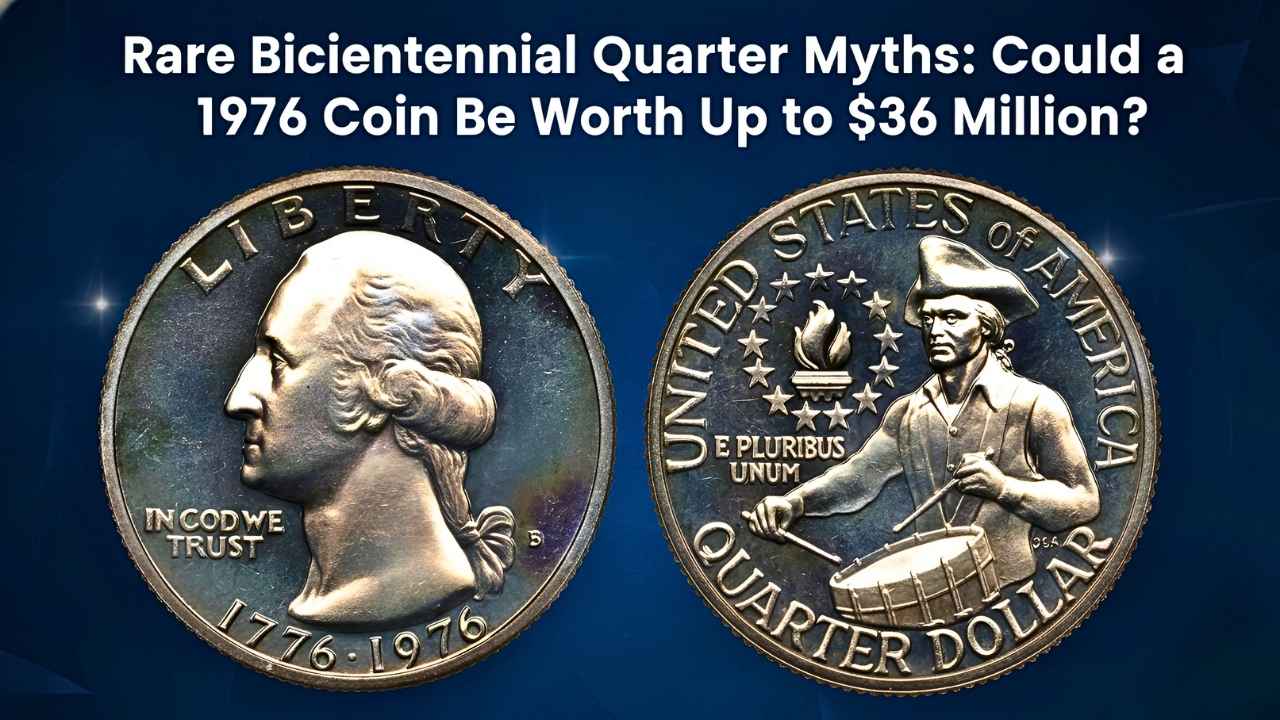
Rare Bicentennial Quarter Myths: In the world of coin collecting, there are countless myths and legends about certain coins that have been passed down over the years. One of the most fascinating stories involves the 1976 Bicentennial quarter, which some collectors believe could be worth up to $36 million. While this claim might sound like something straight out of a treasure-hunting adventure, it has captured the imagination of many. But is there any truth behind the hype, or is it just a myth that has been blown out of proportion? In this post, we will take a closer look at the Bicentennial quarter, explore the myths surrounding it, and try to separate fact from fiction.
The Bicentennial Quarter: A Commemoration of America’s 200th Anniversary
The 1976 Bicentennial quarter was issued as part of a series of special coins created to commemorate the 200th anniversary of the United States’ independence. The coin features a unique design, with the reverse side showing a colonial drummer and the inscriptions “200 YEARS OF LIBERTY” and “1776-1976.” The obverse side still features the portrait of George Washington, but the design was slightly altered for this special edition to make room for the bicentennial details.
The U.S. Mint produced millions of these quarters, which were circulated throughout the country as part of the celebrations. While the coin was meant to honor America’s past, it also became a popular item for collectors. Given the significance of the Bicentennial, many people started saving these coins, and over time, they began to be regarded as potential treasures by numismatists (coin collectors).
The Myth of the $36 Million Bicentennial Quarter
Now, let’s address the big question: Could a 1976 Bicentennial quarter really be worth $36 million? The short answer is no, but there’s more to the story. The claim that a 1976 quarter is worth such an astronomical amount has been circulating for years, but it’s based on several misunderstandings and exaggerations.
The confusion likely stems from the fact that rare coins can sometimes fetch millions of dollars, especially if they are error coins or have been struck with significant flaws. And indeed, error coins can sometimes be worth substantial amounts of money. However, the notion that a standard 1976 Bicentennial quarter is worth anywhere near $36 million is more fiction than fact.
So, where did this idea come from? There are several factors that have contributed to the myth:
- Misunderstanding About the Coin’s Rarity: Many collectors believe that certain Bicentennial quarters are rare or contain unusual features, like misprints or errors that could make them more valuable. While error coins can be worth a great deal, it’s important to note that the vast majority of Bicentennial quarters were produced in large quantities and have no significant defects or special features.
- The Value of Error Coins: Some of the highest-valued coins in history have been error coins—those that were mistakenly produced with flaws or irregularities. For example, certain misstruck or double-die coins can fetch hundreds of thousands or even millions of dollars. The myth about the $36 million quarter likely stems from the idea that an error coin could be found in circulation, despite the fact that there is no confirmed report of such a high-value Bicentennial quarter.
- The Popularity of Coin Hoarding: During the 1970s, the Bicentennial quarter became a popular coin for collectors. People saved them thinking they might be worth something in the future. Over the years, this has led to a widespread belief that these coins are all valuable, even though only a small percentage of them might be worth more than face value.
The Real Value of a 1976 Bicentennial Quarter
So, if a 1976 Bicentennial quarter isn’t worth millions, what is its actual value? In general, a regular, uncirculated Bicentennial quarter is worth only a small premium over face value. While a typical quarter from this era might be worth 25 cents, a 1976 Bicentennial quarter in excellent condition could be worth anywhere from $1 to $5, depending on its grade and whether it’s uncirculated. Coins that have been professionally graded and are in mint condition could fetch slightly higher amounts, but even these rarely go for more than $10 to $20.
However, there are some rare variations and misprints that could increase the value of a Bicentennial quarter. Here are a few examples:

- The 1976-D Silver Proof Quarter: While most Bicentennial quarters were made of copper-nickel, a limited number of silver proof coins were produced for collectors. These silver proof quarters are worth more than regular quarters, with prices typically ranging from $10 to $50, depending on their condition.
- Bicentennial Quarter Errors: There are a few known errors that can make certain Bicentennial quarters more valuable. For example, some quarters were misstruck, leading to variations in their design or size. These error coins can sometimes be worth hundreds or even thousands of dollars, depending on the severity of the error.
- High-Grade Coins: Coins that have been preserved in pristine condition can sometimes fetch a premium price. For example, a 1976 Bicentennial quarter that has been graded as a perfect specimen by a professional grading service (such as PCGS or NGC) might be worth more than one in lower-grade condition.
Why the $36 Million Claim is So Misleading
The story of a $36 million Bicentennial quarter appears to be a case of extreme exaggeration. In reality, even the rarest Bicentennial quarters with significant errors or imperfections have never come close to such a high value. The $36 million figure is likely a result of misreporting or wishful thinking, compounded by the fascination people have with the idea of striking it rich with a simple coin.
In fact, the highest price ever paid for a Bicentennial quarter, or any coin from that era, is far below this mythical figure. While some of the rarer coins from this period have sold for tens of thousands of dollars, none have ever reached anything close to $36 million. To put this in perspective, the most expensive coins in the world, such as the 1933 Double Eagle gold coin, have been valued at around $20 million, and these coins are significantly rarer and more valuable than any Bicentennial quarter could ever be.
What to Look for in a Rare Coin
If you’re interested in coin collecting and want to know how to spot a valuable coin, it’s important to understand the factors that contribute to a coin’s value. While most coins, including the Bicentennial quarter, are not worth millions, there are still rare and valuable coins to be found.
Here are some general guidelines for identifying rare coins:
- Look for Errors: Misprints, double dies, and other production mistakes can increase a coin’s value. However, these errors are often subtle, so it’s important to be familiar with the types of mistakes that can occur.
- Condition is Key: The condition of the coin plays a major role in its value. Coins that are in mint or near-mint condition are worth more than those that have been heavily circulated and worn.
- Rarity: Coins that were minted in low numbers or have a unique history are often more valuable. For example, coins from specific mints or years may be worth more than others due to their rarity.
- Get Professional Appraisal: If you believe you’ve found a rare coin, it’s always a good idea to have it appraised by a professional numismatist or a reputable coin dealer. They can help you determine its true value and guide you on what to do next.
Conclusion
While the idea of a 1976 Bicentennial quarter being worth $36 million is an exciting and tantalizing myth, the reality is far more modest. Most Bicentennial quarters are worth only a small premium over face value, unless they feature rare errors or are in exceptional condition. While error coins and high-grade specimens can be valuable, the myth of a $36 million coin is simply that—a myth.
If you’re a collector, keep an eye out for those rare and unusual coins that do have significant value. And remember, while not every coin is a treasure, there’s still plenty of excitement and joy to be found in the world of numismatics.
