
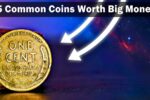
1953 Wheat Penny Value Soars: The 1953 Wheat Penny, once considered just another coin from the mid-20th century, has been gaining attention in the numismatic world for its surprising increase in value. Initially worth just a single cent, some of these pennies are now fetching extraordinary prices at auctions, thanks to rare minting errors and their status as vintage collectibles. If you’ve come across a 1953 Wheat Penny tucked away in your collection or hidden in a jar of spare change, it might be time to take a closer look. The value of this seemingly ordinary coin has soared, and rare versions with minting errors are now worth big money.
The Legacy of the Wheat Penny
The Wheat Penny, formally known as the Lincoln Cent, was minted from 1909 to 1958, with the obverse featuring President Abraham Lincoln and the reverse adorned with two stalks of wheat. This iconic design was created by artist Victor David Brenner and became a symbol of the U.S. Mint’s commitment to both history and craftsmanship. By 1953, the Wheat Penny was nearing the end of its production cycle, with the design eventually being replaced by the Lincoln Memorial in 1959.
Even though the Wheat Penny ceased production in 1958, its legacy has endured among collectors. The coins, particularly those from the earlier years, have become highly sought after due to their historical significance and unique design. While most Wheat Pennies aren’t worth more than their face value, certain years especially 1953 have seen substantial increases in their value due to various rare characteristics, including errors in the minting process.
The 1953 Wheat Penny: A Rare Find
The 1953 Wheat Penny, minted in both Philadelphia (no mint mark), Denver (D), and San Francisco (S), stands out for several reasons. Not only was it one of the last years the coin featured the iconic wheat design, but certain varieties and errors have made the 1953 Wheat Penny highly collectible. A typical 1953 penny in average circulated condition may still be worth only a few cents, but some rarities from this year can command high prices at auction.
It’s important to note that the value of a 1953 Wheat Penny depends largely on its condition, mint mark, and whether it has any rare minting errors. Coin collectors, or numismatists, are particularly interested in specific errors that occurred during the 1953 mintage, making these pennies much more valuable than those without such flaws.
Common and Rare Minting Errors
There are several key minting errors that can significantly increase the value of a 1953 Wheat Penny. These errors are often the result of mishaps in the minting process, such as improperly aligned dies or damaged equipment. While such errors are uncommon, they can be a jackpot for collectors who are on the lookout for rare specimens. Below are some of the most sought-after errors that could turn a 1953 Wheat Penny into a prized possession:
1953 Double Die Penny (DDO)
One of the most valuable and well-known errors is the Double Die Obverse (DDO), which occurs when a coin is struck more than once by the dies, resulting in a doubling effect on the lettering or numbers. In the case of the 1953 Wheat Penny, the most noticeable sign of the DDO error is found in the word “Liberty” and the date “1953” on the obverse. In these cases, the lettering appears double, giving the coin a unique and distinct look.
A well-preserved 1953 Double Die Penny can fetch anywhere from $50 to several thousand dollars, depending on the condition and the extent of the doubling. The more prominent the doubling, the more valuable the coin is to collectors.
1953 Over-Mintmark Errors
Another error that can boost the value of a 1953 Wheat Penny is an over-mintmark error. This occurs when a coin is struck with a mintmark that is mistakenly overlaid with another. For instance, a penny that was intended to have a “D” mintmark (indicating it was struck in Denver) may have an “S” mintmark (indicating San Francisco) over it, or vice versa. These over-mintmark errors are quite rare and highly desirable among collectors.
For those looking for a 1953 Wheat Penny with this type of error, values can range from several hundred to a few thousand dollars, depending on the rarity and condition of the coin.

1953 Lincoln Cent “Cracked Die” Errors
Cracked die errors occur when a die used to strike the coins develops cracks due to wear and tear. These cracks often appear on the coin’s design, and sometimes they can result in visible lines or even raised areas on the coin’s surface. In the case of the 1953 Wheat Penny, cracks might appear on Lincoln’s neck or the date itself. While these errors aren’t as striking as a double die, they still attract collectors due to their unusual nature.
Coins with cracked die errors are typically worth more than regular pennies, and in excellent condition, they can command a few hundred dollars or more, depending on the extent of the crack and the visibility of the error.
Coin Condition and Grading
When it comes to evaluating the value of a 1953 Wheat Penny, condition is crucial. Coins are graded based on their wear and tear, and higher-grade coins are typically more valuable. Coins are graded on a scale from Poor (P-1) to Perfect Mint State (MS-70), with collectors looking for coins in as close to mint condition as possible. A 1953 Wheat Penny with no visible signs of wear and tear, sharp details, and no scratches or marks is much more valuable than one that has been heavily circulated.
Coins with errors that are also in high-grade condition can fetch significantly higher prices, as collectors are willing to pay a premium for both rarity and preservation. Pennies with rare minting errors in exceptional condition may fetch anywhere from $500 to over $10,000 in some cases.
Where to Sell Your 1953 Wheat Penny
If you believe you have a rare 1953 Wheat Penny with an error, it’s essential to have it professionally appraised. Consider contacting a reputable coin dealer or a numismatist who can accurately evaluate its worth based on its condition, rarity, and error type. You can also explore online marketplaces like eBay, where rare coins are often sold through auctions. However, be cautious and make sure to authenticate the coin before any transaction.
For high-value coins, it’s recommended to have them graded by a professional grading service, such as the Numismatic Guaranty Corporation (NGC) or Professional Coin Grading Service (PCGS). Having your coin graded by one of these organizations can help ensure that potential buyers take your coin seriously and recognize its true value.
Final Thoughts
The 1953 Wheat Penny, once a common coin, has become a rare treasure for collectors, particularly those who specialize in minting errors. Whether it’s a double die penny, an over-mintmark error, or a cracked die, the value of these coins has skyrocketed in recent years, with some fetching thousands of dollars. If you happen to have a 1953 Wheat Penny in your collection, it may be worth investigating further—it could be worth a lot more than you think.
