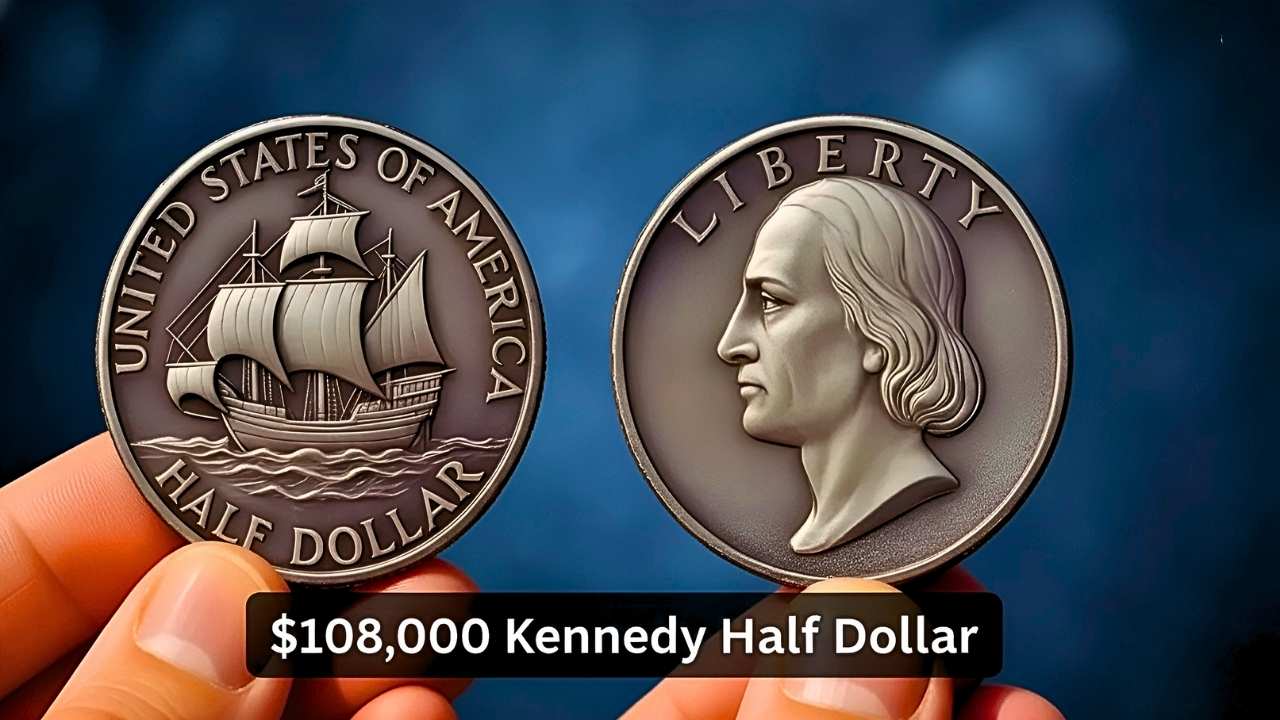
$108,000 Kennedy Half Dollar: Coins are often thought of as humble forms of currency, with their value measured simply by their face value. But in the world of numismatics, certain coins can far exceed their face value, becoming rare treasures worth far more than their weight in gold. One such coin is the Kennedy Half Dollar—a coin that, at its peak, has been sold for a staggering $108,000. But how did this 50-cent piece go from being a regular circulating coin to becoming one of the most valuable coins in the world? Let’s take a closer look at this incredible story.
The Origins of the Kennedy Half Dollar
The Kennedy Half Dollar was first minted in 1964, shortly after the assassination of President John F. Kennedy. The coin was introduced as a tribute to the late president, who had been assassinated in November 1963. The U.S. Mint, under the direction of then-President Lyndon B. Johnson, decided to replace the Franklin Half Dollar with a new coin featuring a portrait of Kennedy on the obverse.
Designed by sculptor Gilroy Roberts, the Kennedy Half Dollar featured a striking image of Kennedy’s profile on the front, while the reverse depicted the presidential seal. The coin was initially struck in 90% silver, reflecting the nation’s historical ties to precious metals. It quickly became a symbol of national mourning and pride.
Over the years, the Kennedy Half Dollar has undergone several changes. In the late 1960s, as silver prices rose, the Mint began reducing the silver content in the coin, eventually transitioning to a copper-nickel composition. Despite these changes, the Kennedy Half Dollar remained a popular symbol, though its use as a circulating coin diminished over time.
The 1964 Kennedy Half Dollar: A Key Date in Numismatics
Though the Kennedy Half Dollar was minted in large quantities, certain years of the coin have become especially valuable. The most significant of these is the 1964 Kennedy Half Dollar. As the first year of production, this coin holds a special place in the hearts of collectors.
One key feature that makes the 1964 Kennedy Half Dollar stand out is its silver content. The coin was minted in 90% silver, giving it a higher intrinsic value compared to later years when the silver content was reduced. The 1964 version is especially coveted by collectors, not only for its silver content but also for its historical significance as the first coin to bear the image of President Kennedy.

However, the 1964 Kennedy Half Dollar isn’t just valuable because of its historical importance. There are some very specific variations and errors that make certain specimens worth far more than their face value. And it’s these rare errors that have led to the 1964 Kennedy Half Dollar becoming more valuable than gold.
The 1964 Kennedy Half Dollar with No Mint Mark: A Rare Error
In 1964, the U.S. Mint produced Kennedy Half Dollars at three different locations: Philadelphia, Denver, and San Francisco. Normally, coins minted in Philadelphia did not carry a mint mark, while coins struck in Denver and San Francisco had their respective mint marks—”D” and “S”—stamped on the reverse side.
However, a rare error occurred during the minting process: a small number of 1964 Kennedy Half Dollars were struck at the Philadelphia Mint without a mint mark. While this may sound like a small detail, it has had a massive impact on the coin’s value. The missing mint mark error is one of the most sought-after variations in the entire series, as most Kennedy Half Dollars from that year were stamped with either a “D” or “S.”
The rarity of these no-mint-mark 1964 Kennedy Half Dollars has made them incredibly valuable among collectors. In fact, a specimen in near-mint or mint condition can easily fetch up to $108,000 at auction, depending on its condition. This makes it one of the most expensive 50-cent coins ever sold. In comparison, the price of gold has historically hovered around $1,000–$2,000 per ounce, so the 1964 Kennedy Half Dollar with no mint mark has, at times, been worth more than its weight in gold.
Why is the 1964 Kennedy Half Dollar So Valuable?
The reason for the 1964 Kennedy Half Dollar’s extraordinary value lies in its combination of rarity, historical significance, and error. Here are a few reasons why this coin is so highly coveted:
1. The Historical Context
The 1964 Kennedy Half Dollar was introduced shortly after the tragic assassination of President Kennedy. As a result, the coin became a symbol of national mourning and a tribute to the president’s legacy. Many collectors seek this coin as a way of honoring Kennedy’s memory, adding a layer of historical significance to its value.
2. The Rarity of the No Mint Mark Error
While the 1964 Kennedy Half Dollar was struck in large quantities, only a few coins were minted without a mint mark. This error makes the coin an anomaly within the series, increasing its desirability among collectors. Coins with minting errors often fetch higher prices because of their uniqueness.
3. The Silver Content
The 1964 Kennedy Half Dollar contains 90% silver, which gives it an intrinsic value above its face value. While the silver content is lower in later versions of the coin, the 1964 version remains a key date for collectors due to its higher precious metal content.
4. The Coin’s Condition
As with any rare coin, the condition of the 1964 Kennedy Half Dollar plays a crucial role in determining its value. Coins in mint or near-mint condition are the most sought after, as they are the rarest and most difficult to find. The higher the grade, the higher the value.
How to Identify a 1964 Kennedy Half Dollar with No Mint Mark
Identifying a 1964 Kennedy Half Dollar with no mint mark is relatively simple, but it’s important to carefully inspect the coin. Here’s what you should look for:
- The Date: The coin must be from 1964.
- The Mint Mark: Check the reverse side of the coin, just beneath the eagle’s tail feathers. If there is no “D” (for Denver) or “S” (for San Francisco), then you have a rare 1964 Kennedy Half Dollar struck at the Philadelphia Mint.
- Condition: The condition of the coin is crucial. Higher-grade coins will command higher prices. If the coin is in good or excellent condition, it will be worth significantly more than a heavily worn example.
If you believe you have found one of these rare coins, it’s always a good idea to have it professionally graded by a reputable numismatic organization, such as the Professional Coin Grading Service (PCGS) or Numismatic Guaranty Corporation (NGC). Certification helps verify the coin’s authenticity and its condition, which in turn affects its value.
The 1964 Kennedy Half Dollar’s Legacy
While the 1964 Kennedy Half Dollar may no longer be a circulating coin, it remains one of the most iconic and valuable coins in American numismatics. The coin’s historical significance, combined with its rarity due to the mint mark error, has ensured that it will forever be a coveted treasure among collectors.

The sale of a 1964 Kennedy Half Dollar for $108,000 highlights the incredible potential for rare coins to appreciate in value over time. What was once a 50-cent piece is now a highly sought-after collector’s item that commands a price many times greater than its face value—or even its weight in gold.
Conclusion
The 1964 Kennedy Half Dollar with no mint mark is a perfect example of how a seemingly ordinary coin can become a valuable piece of history. Its rarity, combined with its historical context and error, has turned it into one of the most expensive 50-cent coins in existence. For collectors, finding one of these rare coins is the ultimate prize—a small treasure that represents the intersection of history, rarity, and numismatic passion.
If you’re lucky enough to come across a 1964 Kennedy Half Dollar with no mint mark, you might just be holding a piece of history worth far more than its face value.
